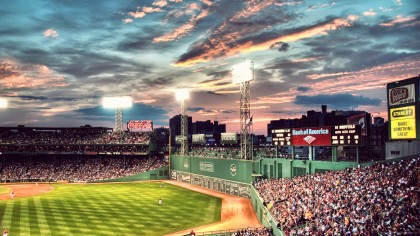










Fenway Park, built in 1912, celebrated its dedication with a World Series championship in its first year of baseball, and again, most recently, in 2013. But beyond its home victories, this sacrarium of summer’s prime pastime stands out as one of Boston’s most exemplary urban settings. Seating 37,499 seats during a game, Fenway Park is a landmark unbeknownst to many out-of-towners. Yet it is perfectly planted within the urban fabric of Kenmore Square’s extended neighborhood.
When Roger Clemens arrived in Boston for the first time in 1984, he took a taxi from Logan Airport and thought the driver didn’t understand his directions when he said, “Fenway Park.”
After the taxi driver stopped, he pointed to what Clemens thought resembled a storage facility and said, “Here we are.” Clemens stalled, unsure of where the driver had taken him.
He recalled telling the driver, “No…Fenway Park, it’s a baseball stadium…this looks like a warehouse.”
Only when the driver told Clemens to look up at the light towers did he realize he was in the right place.
Fenway Park is not your typical modern-day Baseball Stadium. Most stadiums reside as big monumental structures clearly set apart from their urban neighborhoods, surrounded by vast parking lots.
Los Angeles’ Dodger Stadium, St. Louis’ Busch Stadium, and Houston’s former Astrodome are great examples of this type of arena. In contrast, Fenway Park and Chicago’s Wrigley Field are outliers among American baseball stadiums and will forever be etched in the public consciousness as America’s most original ballpark designs.
In many ways, Fenway Park is indistinguishable from its surrounding Kenmore Square / Fenway neighborhood. The Park (or “pahk,” in local dialect) is embedded within a collection of two- and three-story brick buildings lining modestly scaled two-lane roads. This might help explain Roger Clemens’ confusion upon first arriving in Boston. (It’s OK, Rog, we’ll eventually find a way to forgive you, but we’ll never forget.)
Fenway Park is carefully scaled to fit in with its surroundings. It has no grand entrances, ramp ways or fences surrounding it. Instead, this urban gem is nestled in the Urban Fabric that is an extension of Boston’s Back Bay. It meets Fredrick Law Olmsted’s Back Bay Fens (a linear parkway that is a segment of his famous Emerald Necklace network of parks and greenswards weaving through several Boston neighborhoods) in such a way that each complements the other seamlessly.
Shaped by the skew network of streets and parkland that surround it, Fenway Park’s peripheral geometry is quirky, which can be explained only by historic circumstances. For this reason, Boston’s ballpark cannot be replicated anywhere else. Its idiosyncrasies are what make it unique, but these oddities are neither contrived nor fabricated — they are authentic. They are rooted in the particular urban development actions taken by many different people and organizations over time. Fenway Park is not some isolated shrine stationed in the outskirts of Boston with parking spaces land locking it into a future tomb. It’s clearly a seamless blend between the historic neighborhoods of Kenmore Square and what is now Boston’s Back Bay.
So what are the unique attributes that make Fenway Park such an exemplary urban design model for integrating large structures into the city? What lessons can be learned from this, and what of its design strategies are transferable to other urban situations?
Buildings as part of an Urban Fabric
Take a look at one of your favorite clothing items, a jacket, dress or coat. Study its texture and feel. Look closer and see how its threads are interwoven to give the fabric a rich feel and comfortable touch. The quality of the cloth is as much determined by the grade of the threads as it is by the type of weave, or what we call a certain fabric.
Urban designers refer to the Urban Fabric as a way of describing the texture, scale and feel of cities and their neighborhoods. A memorable neighborhood often has a distinctive urban fabric, be it Amsterdam’s canal-lined blocks, Barcelona’s uniquely gridded pattern of chamfered blocks, or the more organic metropolitan textures found in the Kasbah of Fez, Morocco.
The best aspect of speaking about urban fabric is that there isn’t just one example of it, but thousands, all irrevocably different from one another.
Each of these cities and its unique urban fabric possesses an underlying character and quality that relate to both the materials and the architectural vernacular found in a region. This character and quality also represents the social and environmental drivers that shape the region’s culture. The neighborhoods are based on urban block structures, building and street types that are integrated synergistically to create environments that are appropriately scaled to people.
Consider, for example, Boston’s unrivaled patriotic inclination as a city. Its bold, individualized, yet strangely cohesive neighborhoods have blended into a seamless fabric of narrow corridors, winding streets and extreme varying seasons, which reflects on its population as being one of America’s most unique.
The best examples of cities with a strong urban fabric have a sense of cohesion and order, with enough variety to make its landmarks, streets, squares and neighborhoods interesting and exciting to experience by foot or other modes of mobility, such as Boston, New York, Washington D.C. and Chicago.
Contrast Washington’s Georgetown neighborhood with your average American “strip” lined with fast-food establishments and strip malls, and you will understand the difference between cities with strong and weak urban fabrics.
In comparison, Fenway Park is successful because its scale fits the surrounding context of its neighborhood. Though the ballpark is a large-scale municipal structure serving thousands of people, from the outside it appears to comprise many smaller structures, each relating in scale and materials to the neighboring buildings. The Park morphs its typology (or building type) to accommodate its surroundings — not the other way around.
Too often, large stadiums within city centers become eyesores. They may be so different in scale and design they lack any kind of connection to their immediate vicinities, despite being modern marvels of architectural design and innovation — we are simply referring to their existence on the outskirts of many cities, as well as their simple, literal replication of similar ballparks built throughout the country during that time period.
The Power of Streets, Paths and Places
Most stadiums are monolithic structures possessing a very strong underlining geometric order that determines the shapes of the spaces and the user’s experiences of them. Stadiums built in the ’60s and ’70s in particular took on the appearance of mega-structures that were not very friendly to human scale. Many of these massive structures have since been torn down.
For instance, Cincinnati’s Riverfront Stadium fell victim to the wrecking ball in 1995. This and other “cookie-cutter” stadiums of the ’70s were designed as multi-purpose arenas for both baseball and football to spare cities the dual costs of hosting two teams. Other stadiums like this proliferated in St. Louis, Atlanta, San Diego, Pittsburgh, New York City, Washington D.C. and Philadelphia.
Many of these cities have since replaced these concrete atrocities with more humanly scaled single-use structures designed exclusively for baseball. They often nostalgically recall baseball’s bygone eras. Fenway Park, Wrigley Field and other older ballparks like it may have inspired these new structures. The first and perhaps best example of this is Baltimore’s Camden Yards, designed by HOK Sport (now known as Populous) and Janet Marie Smith, the architect of Fenway Park’s recent renovation.
But what distinguishes Fenway Park from other ballparks is not only its rich history, but also its unique circulation system. The network of streets outside it is seamlessly integrated with the systems of paths, stairs, ramps and places within the bowels of the Park proper.
When approaching the Park from one of the narrow streets, visitors find themselves slipping through an entrance that feels more like an entry into a car-repair garage. They are then shuttled along tightly scaled spaces below the underbelly of the infield stands. The tightly constricted spaces then explode skyward as visitors approach Gate B. This space is more like a public plaza, bounded public market-style by cafes, shops, and concession stands. People sit at tables, consuming hot dogs and beer, as waves of people flow through the spaces inning by inning.
The effect is dramatic, akin to urban theater – but uniquely Boston.
The Power of “Section” – the architectural equivalent of an MRI
Adding to Fenway Park’s architectural and urban design drama are the bridges and ramps that crisscross its main circulation paths. Every turn along these paths reveals a new surprise, as bridges fly overhead leading visitors to upper decks and the bleachers.
(Fenway’s architectural drama recalls the great engravings of the Italian artist Piranesi – a master at representing fantastic spaces composed of walls, columns, bridges, and stairs. His visionary works were inspired in part by what he saw in Rome from 1748 to 1774. But they also were prescient of architectural and urban possibilities that were centuries in waiting. See the Piranesi Interactive Portfolio here: http://bit.ly/1nxbHIu)
What helps make architectural spaces dramatic is the quality of the “section.” A building section is like taking an MRI image of a structure. It allows you to see the interior spaces, their shape, materials, and how light enters the spaces.
Fenway has great sections!
The sections and the shapes of the spaces are always changing as you walk along the circulation spine. This is because the shape of the overall ballpark is so unique and idiosyncratic, unlike the generic stadiums of the 1970s. Every corner of the park reveals a different experience, none more dramatic than entering the baseball field itself. Visitors rise up from beneath the darkened spaces beneath the tribunes by following gently sloped ramps toward this hallow ground. As the field comes into full view in all its glory, the shape of the stadium gently embraces its visitors. Scanning the stadium’s full panorama, the eye finds interest and delight in all of the unique features and details that make Fenway Park so special. The Green Monster (that oversized 37-foot fence in left field) looms large, as special bleacher sections are perched from it over the street below. Every tribune and balcony is slightly different, whether by virtue of its shape, material or detail, yet all are related like members of a large extended family.
This is where the contemporary or “cookie-cutter” park fails – it is too predictable, too perfect, such that surprise and idiosyncrasy are avoided for fear of unsettling the visitor. No, idiosyncrasy creates personality, and more personality is a welcome reprieve in in a world that is becoming flatter and more identical.

Final Observations and Credits
It is hard to believe that only 16 years ago there were proposals to tear down Fenway and replace it with another structure. One proposal called for replicating the same footprint of Fenway, but at an adjacent site with more modern features. The field would be below current grade level, allowing for more seats. The argument made by prospective owners was that modern-day baseball teams could not compete unless they offered fans the fancy luxury boxes and amenities found in many contemporary stadiums. Luckily those proposals failed.
The new ownership headed up by John Henry decided to renovate and the park over a ten-year period, making incremental changes every year. The rest is history as it were. The Red Sox won the World Series and broke the curse of the Great Bambino (Babe Ruth) in 2004, 2007 and, most recently, 2013. Since the new ownership came in, the Park has been mostly sold out (820 games continuously sold out!), allowing the team to support a financially healthy and largely successful team. Fenway Park renovations are now said to be in code through the year 2040!
Red Sox President Larry Lucchino played a key role in realizing this strategy. In 2002 he hired Janet Marie Smith, who had worked with him on Camden Yards in Baltimore, to renovate Fenway Park. Despite “loud calls for the demolition of Fenway Park” — even from Ted Williams when he was still alive — Smith’s tenure witnessed a transformation of the park, adding some 5,000 new seats and remedying structural and long-neglected maintenance issues. All the while, the Park’s quirky charm lives on as it continues to infuse the magic and history of Boston into the denizens of the new century.
Special credit should be given to our neighbors, D’Agostino-Izzo Quirk, the Boston architectural firm working with the Red Sox, and Smith over the ten-year renovation. They have illustrated the benefits of this thoughtful process and shown us how a “pahk” can live on for generations to come.
Images:
www.wallpaper.pickywallpapers.com/2560×1440/fenway-park.jpg
www.i.usatoday.net/sports/_photos/2012/01/03/Monster-roots-Fenway-at-100-SQU17GF-x-16-9.jpg
By Cameron King / Paul Lukez
Edited by Todd Larson
Paul Lukez Architecture