








Boston, Massachusetts has always had a legacy of greenways which help connect river ways, century-old parks and the harbor. Being the walkable-city that we are (currently third behind New York City and Washington D.C. according to Walk-Score) Boston boasts some visionary plans, shaped in part by famous landscape architects Frederick Law Olmsted and Charles Eliot. Among other planners they helped revolutionize Boston’s system of public spaces. Ironically, Boston is ninth-worst in the country for our traffic. In 2011, former Mayor Menino pledged to change Boston’s traffic issues by 2030, hoping to boost the rates of walking, biking and public transit usage.

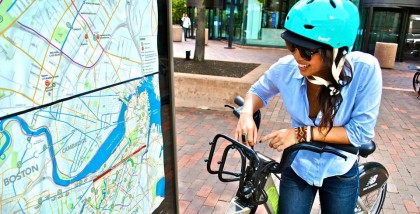
To meet this ambitious goal, the Mayor made a major commitment to the “Hubway” bicycle-share system. On Earth Day, April 21, 2011 Mayor Menino signed an agreement with the City of Boston that helped change the way people get around Boston.
Hubway, whose parent company is Alta Bicycle in Portland Oregon, was originally funded by 4.5 million dollars in grants from the Federal Transit Administration. Hubway also obtained local sponsorship from New-Balance. Hubway has seen not only its financial value increase significantly, but the benefits it provides urban residents and visitors alike has transformed in just three years. With several other, ‘bike-sharing’ systems sprouting up in cities like Washington D.C. San Diego, Chicago and New York, these systems are changing the urban landscape and how we get from one place to another. The Boston Bike Program continues to build excitement and ridership with over 140 stations servicing 1,300 bicycles throughout Boston, Cambridge, Somerville, Newton, Brookline, Medford and other neighboring towns.
Coincidentally the Greenway Links Initiative is a community based project that could work in concert with Hubway’s corporate and civic objectives. This initiative advocates expanding non-motorized infrastructure such as walking, hiking, running, bicycling and skating along the city’s already expansive urban network and its adjacent suburbs. A key next step is to strengthen and improve the pathways and networks along the Mystic, Charles and Neponset Rivers so as to create a seamless system of recreational and green mobility corridors throughout metropolitan Boston. In essence connecting all of Boston through non-motorized roadways.
More info on Greenway Links Initiative Here
Taken together, The Greenway Links Initiative and Hubway bicycle-sharing system could prove to be a grand slam for Boston residents and surrounding cities. Adding to the already established, but separate, community pathways (such as the Somerville Community Path and the Harborwalk in Medford), the potential for connectivity between Boston neighborhoods could help mitigate traffic issues. Members of the initiative believe the already planned expansive network could be as successful as past projects spearheaded by the Esplanade Association and their work along the Charles River. Renovations along the Emerald Necklace area and the southwest corridor in Jamaica Plains also come to mind as great examples of civic minded urban initiatives. These past projects have helped revitalize neighborhoods and cultural centers along these corridors. They also helped encourage pedestrian traffic while improving the urban landscape for residents.
Jackie Douglas, Executive Director of LiveableStreets said about the Greenlinks Initiative, “This is the future. The future is greenway paths that are linked together so that instead of stopping and starting, you can walk or bike continuously from one (area) to another.”
Greenway Links Continuous Planned Route (In Yellow)

The recreational opportunities for residents could be endless. The Greenway Links Initiative hopes that revitalized corridors, can serve as a catalyst for neighborhood economic development.
In short, the Greenway Links Initiative seeks to extend, connect and revitalize an urban park system to reflect Boston’s current needs as a city. While already packed to the brim with too much traffic, residents, commuters and visitors to the city would have alternate modes of travel from which to choose. Hubway looks to be a key contributor in helping meet the Mayor’s goals. By offering a linear system of urban pathways for non-motorized transportation options, Boston is developing a great model for more economically and environmentally sustainable urban systems. Best of all, this evolving green network is tied to open spaces in a way that further enhances the urban experience of Boston residents and visitors.
More Details about ‘Hubway’
The Hubway system is very simple. Hubway, was launched on July 28th, 2011 with 600 bicycles and 60 stations at the time. Over the course of four months, Hubway caught on with the general public and gained 3,600 users by December 1st, 2011. It logged 100,000 bicycle rides in its first two months alone, making it one of the most successful programs of its kind in the country.

Users may unlock bicycles 24 hours a day, seven days a week. The service is open from mid-March to late November (open year round in Cambridge.) People can rent a bicycle for up to 30 minutes from any of the 140 Hubway stations around the city. Fees rack up after 30 minutes of use, ranging from $2-$100, depending on the return time of the bicycle. Steep you say? Not really, it is free so long as you return your Hubway bicycle to another station within 30 minutes. Users may purchase a Hubway system (3 season pass) for only $85 annually with unlimited access.
Photo bibliography: http://architects.org/committees/news/greenways-shaping-boston
http://www.urbanadventours.com/wp-content/uploads/2013/03/hubway-featured.jpg
http://www.altabicycleshare.com/assets/images/altabicycleshare/sliders/orbit/Hubway%206.jpg