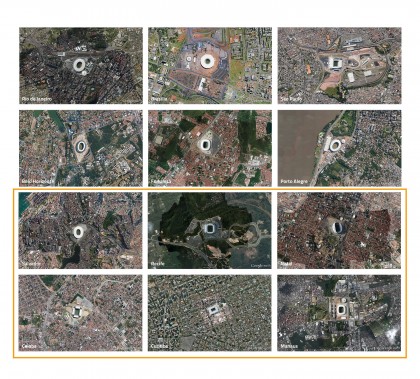









We posted the first of a two-part blog on the World Cup Stadiums of Brazil and their impact on the host city’s urbanism.World Cup Urbanism – Part I
Today we invite you to scan the remaining six stadiums as we await in anticipation the results of the remarkable 2014 World Cup.

Itaipava Arena Fonte Nova, Salvador, Bahia, Brazil (capacity: 51,708)
Located in one of Brazil’s oldest and most historic cities, Itaipava Arena Fonte Nova and its support structures (parking, public plazas, etc.) have an organic relationship with its context.
Fitting nicely within the surrounding neighborhoods and highways, the stadium does appear to have been built in moderation, providing an appropriately scaled buffer zone in-between neighborhood developments and the arena. Nestled between three different neighborhoods, it appears inextricably intertwined with Salvador’s neighborhoods and its system of roads and public spaces.
Facts about Itaipava Arena Fonte Nova in Salvador, Brazil
• It is located in Salvador, Bahia, Brazil.
• It was rebuilt by German architects in 2006.
• The present stadium, designed by Marc Duwe and Claas Schulitz, opened April 7, 2013.
• Its roof collapsed on May 27, 2013, after heavy rains.
• The stadium will host several games in the 2016 Summer Olympics.
• Salvador means “City of the Holy Savior of the Bay of All Saints.”
• Salvador is located on Northeast coast of Brazil.
• Known as Brazil’s “capital of happiness” due to its countless popular outdoor parties, Salvador hosts the world’s largest carnival.
• Salvador houses 3.5 million people, making it the third most populous Brazilian city.
• Salvador is home to Porto da Barra Beach, named “the third best beach in the world” by The Guardian in 2007.
• Salvador is nicknamed “Black Rome.”
• Founded in 1549, Salvador is one of Brazil’s oldest cities.

Itaipava Arena Pernambuco, Recife, Brazil (capacity: 42,583)
With the appearance of a modern-day sports facility, Recife hosts the closest relative of its American sports counterpart. Friendlier to cars than pedestrians, Itaipava Arena Pernambuco boasts ample parking. Located on the outskirts in this Northeastern Brazilian city, it is very much like a Gillette Stadium in Foxboro, Mass. (home to the NFL’s Patriots), also occupying an ex-urban site.
Known as “the Brazilian Venice,” Recife may have made it difficult for planners to plant this arena within the city’s fabric, thus placing it on the outskirts, where space is more abundant.
Notice the quadruple lane highways providing easy access to the stadium and parking lots. A road system circumscribes the stadium’s parking, allowing for quick vehicular entry and exit.
Facts about Itaipava Arena Pernambuco in Recife, Brazil
• Recife recently built this stadium for the Brazil World Cup and the Summer 2016 Olympics at a cost of $226 million in US dollars.
• The stadium is located in Sao Lourenço da Mata, Pernambuco, Brazil.
• Its home team is the Clube Nautico Capibaribe fútbol club.
• Recife is the fifth largest city in Brazil, with 3.8 million people.
• Located in the northeast region of Brazil, Recife is a major port city and is often called “the Brazilian Venice.”
• Many reefs, small bridges and islands cover the Recife City Center.
• The city has more than 53,500 business centers.
• It also has Brazil’s second largest medical center (second only to São Paulo) and is known for providing the best infrastructure for travelers and businesspeople, though there is wide room for improvement.

Arena Pantanal, Cuiabá, Mato Grosso, Brazil (capacity: 41,112)
Arena Pantanal, officially Arena Multiuso Governador José Fragelli, is a hybrid stadium of sorts. It is separate from its context, but its landscaping and public spaces are loosely integrated with the adjacent neighborhoods and roads. The result is a colorful urban collage.
While the somewhat diamond shape of the plot and the near-ellipse form of the arena enable the overview to really showcase the buffered zone between surrounding neighborhoods, one may consider the stadium oddly aligned in the urban fabric. Layered with parking lots able to satisfy some of the attendees, the larger somewhat square layout allows for a well-placed medium between the residential fabric and commercial arena.
Facts about Arena Pantanal in Cuiabá, Brazil
• It was the last stadium completed for the 2014 World Cup, at a cost of $293 million in US dollars.
• The stadium was built as a sustainable structure, replacing
• It is located in the exact center of South Brazil.
• Cuiabá was founded in 1719 during the gold rush and has remained a city ever since.
• Cuiabá’s main trade focuses are cattle-raising and agriculture.
• Cuiabá’s economic development has been hampered because of its physical isolation in Brazil and its shortage of incoming labor into the landlocked city.
• Riverboats are an important means of transportation to Cuiabá.
• Cuiabá is notable for its cuisine, dance, music and craftwork.
• It is located in the southwestern region of Brazil.

Arena da Amazônia, Manaus, Brazil (capacity: 40,549)
The sinuous geometry of the Great Amazon River that runs through Manaus is not evident in the gridded layout of the Arena da Amazônia (Amazon Arena) or its surroundings. Its industrial environs are a giveaway to the economic powerhouse that is Manaus and its vast urban importance within the encapsulating Amazon Forest.
As if defying nature’s power, this stadium complex creates a highly ordered series of parcels and blocks — perhaps the beginning of a new part of the city. Clearly defined and orderly, the Arena de Amazônia is part of a larger industrial and multi-use district of Manaus.
Facts about the Arena da Amazônia in Manaus, Brazil
• Construction began in 2011.
• It was designed by the German architecture firm of Gerkan, Marg and Partners.
• It includes an on-site rainwater recycling system and sewage treatment facilities to reduce its water usage.
• More than 95% of the old Vivaldo Lima stadium’s wreckage was used to build the new one.
• It officially opened March 9, 2014, as the second-to-last stadium to open for Brazil’s World Cup.
• Arena da Amazônia is the World Cup’s most geographically isolated arena.
• Manaus is the capital city of the Amazon region of Northern Brazil.
• The city was founded in 1693-94.
• Its name means “The City of the Margins of Black River.”
• Manaus’s main exports are electronics, chemical products, soap, construction, nuts, rubber, jute and rosewood oil.
• With 1.9 million people, Manaus is the Amazon’s most populous area.

Arena das Dunas, Natal, Brazil (capacity: 39,971)
A spectacular architectural edifice in its own right, the Arena das Dunas (Dunes Arena) mediates the conflicting geometries of its adjacent neighborhoods while abiding by the standards of great stadium design. However, therein lies the challenge, as the existing context does not abide by the arena’s geometry, yielding oddly shaped leftover spaces around its perimeter. What is the quality of these spaces, and do they match that of the architectural object?
The most praised stadium by FIFA officials before the World Cup started, the Arena das Dunas also boasts an artificial lake, shopping center, commercial buildings, hotels, and an underground parking structure.
Facts about the Arena das Dunas in Natal, Brazil
• It was designed by sports arena architect Christopher Lee of Populous.
• This stadium received the highest recognition from FIFA inspectors.
• Natal has a population of 950,000 and is located in the Northeastern region of Brazil.
• Natal is known for its cashew trees and historical monuments and beaches.
• It is also known for its offseason carnival, “The Carnatal.”
• It is the city closest to Africa and Europe.
• Natal is often called “City of the Sun” and “City of the Dunes.”

Arena da Baixada, Curitiba, Paraná, Brazil (capacity: 39,631)
Curitiba is world-renowned for its forward-thinking sustainable design programs initiated by Mayor Jaime Lerner, an alumnus of MIT’s School of Architecture and Planning.
The geometry and scale of Arena da Baixada (officially Estádio Joaquim Américo Guimarães) is sensitively and sustainably integrated into the surrounding neighborhoods. In addition, humanly scaled public spaces shape and feed the arena. The result is a thoughtful renovation, as this stadium fits tightly into the fabric of Curitiba the way the Amphitheatre of Pompeii nestles into its city’s gridded block pattern.
Facts about Arena da Baixada in Curitaba, Brazil.
• The original stadium was built in 1934, closed down in the 1970s, reopened in 1984 and demolished in 1997.
• It was rebuilt in 2005 as Kyocera Arena, after the Japanese phone company.
• A retractable roof was intended for the new stadium, but labor infringements delayed and finally cancelled that plan.
• As of April 24, 2014, 27,000 seats were still to be installed in the arena.
• Curitaba’s population was approximately 1.7 million as of 2010.
• Curitaba is the largest city in Brazil’s southern region.
• The city has ample land for cattle-grazing and agriculture.
• 1850 saw a lot of European immigration to Curitaba, contributing to its cultural development.
• In 2010, the city received the “Global Sustainable City Award” for excellence in urban development, and Reader’s Digest named it the best “Latin American Big City” in which to live.
Final Thoughts
For all of the excitement associated with the World Cup and its preparations, the massive investment of over $11 billion into stadium construction throughout Brazil, has been a source of major social and political strife in Brazil. Important questions about how much should be invested in “games” vs. education, public services, transit and other primary public interests must be addressed. For this reason, the design of the stadiums and their relationships to the urban fabric of their host cities must be well considered. Can these structures and the range of uses they support evolve over time so they can generate more social, educational and economic benefits to local and regional economies?
This is where architects, urban designers and planners can contribute ideas that have potentially long-term benefits, especially if we think about how our designs fit into and evolve within the urban systems over time — not as singular objects glorifying one fleeting moment, but as armatures for spaces and functions that sustain and enrich civic and urban life in the long term.