











Stana Odrljin
1) What is your full name and where are you from?
My name is Stanislava Odrljin and I am from Split, Croatia! (Yes, I speak Croatian)
2) What is your position here and how did it come about?
I am a designer here and actually, I work for a firm back in Split and the owner of our firm closed the firm down for six weeks over the summer. So I decided to come back and visit my mom (who lives in Boston) and I wanted to spend my time constructively, so I began searching for an opportunity to continue using my skills and PLA was among the top firms I wanted to work for. Paul reached back out to me after I emailed him in early summer and invited me over for a six week internship.

Stana’s apartment in Split, Croatia.
3) How did you get into the field of Architecture and Design?
Actually, it’s kind of funny, I got into architecture accidentally because, I wanted something technical but had creative elements. Architecture just happened come across my path and I began to like it because it did allow me to be creative, but hone the technical skills which I was also good at.
4) What drives you to continue in this field?
I had a really good experience in school. It was really awesome to be able to dream big right out of the gate. The whole architecture field was really interesting because it’s part of the everyday world. Everyone deals with architecture at every point throughout their day, at work, through transportation venues, public places and then at the end of the day back home. So to be able to take part in the design process for all of these things is really exciting.
For school, I attended Zagreb University (Zagreb is the capital of Croatia) and have a Masters in Architecture and Urban Design.
5) What is the hardest part about being in design? The long hours/days, constant change of project scope?
The shift from school to the workplace is pretty difficult. Design can be really demanding, rewarding, but severely demanding. In the architecture world, you need to work and then work some more. In school, even though it is as demanding, you do have more free time to work on a few chosen projects (a little bit) and less restrictions on life overall. So, with that mind, the real world has budgets and other restrictions, in school your mind is free to flow with the projects and there is no constantly changing project scopes.
Definitely the toughest part of the long hours and days can be not being able to spend as much time with your friends and family as much as when you’re in school, or on the weekend. Being with people, integrating and going new places is definitely what helps me be creative, so the long hours can definitely affect that. I think it’s supremely important to recharge with friends and family, especially while working with architecture.

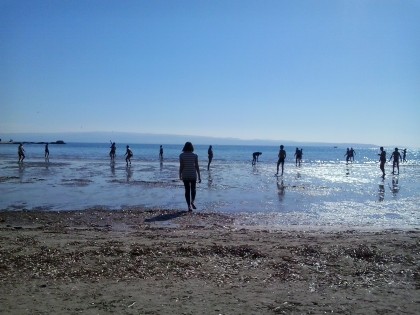
Photo of Stana walking into one of Split’s many beaches.
6) So, how do you relax? What hobbies do you do in your spare time?
Definitely going on little adventures, being outside and going for walks. Having coffee with friends and travelling as well definitely helps too. Exploring cities and seeing new and different kinds of architecture really helps restore the creative juices as well. Without it, you can feel drained. I’ve also started learning how to play the guitar and I like to read books. Generally, being outside and sharing time with friends in the best way for me to relax.
7) So, you’re from Split, Croatia. Which I’m sure for most people is pretty hard to point out on a map. Tell us about it from your perspective.
I’ve only been in downtown Split for a little while (a year and a half) and living on a coastal town of the Mediterranean is unbelievable. Everyone is always outside, the lifestyle is very slow and people focus more on relaxing than work sometimes. The weather is very nice for most of the year. People are very connected to being outdoors and with nature and people from Split, really love their city and are proud of it.
NOTE: Split, Croatia is home to Dicoletian’s Palace. This palace is today, with all the most important historical buildings, in the center of the city of Split. Diocletian’s Palace far transcends local importance because of how well it is preserved. The Palace is one of the most famous and complete architectural and cultural features on the Croatian Adriatic coast. As the world’s most complete remains of a Roman palace, it holds an outstanding place in Mediterranean, European and world heritage.

Photo of Stana in overlooking the industrial section of Split, Croatia.
8) Where else in Europe would you recommend traveling to?
I would absolutely recommend traveling to Lisbon, Portugal. I think it is a wonderful place, very unusual, awesome people; it has a lot of the same qualities as Split, but also has Muslim and African influences in it too, which add a lot of new things to experience. Also, Istanbul, Turkey is a crazy place. For a city that’s been ruled by so many different eras through the times, you can really notice the layers of culture and history. There are so many people in Turkey and places to go and explore.
9) How much time have you spent in the states? Do you think it’s totally different than Europe? What are the differences you’ve noticed?
I grew up in the states for 11 years total. So I’m not a total tourist (haha). I think Americans are really open and kind, which is their best quality. Europeans are generally more liberal, but can be cynical in ways. Americans are really friendly and outgoing too. In terms of the differences for the lifestyle, most Europeans live in cities, close to transportation and generally do not have a car. In the US, everything is expanded and people are more oriented to their friends, family, and personal spaces, despite being social to everyone. Europeans I think, tend to use public spaces more than Americans (as of now) and I think Americans are just now beginning to centralize into cities and abandoning their cars or the suburbs.

Stana’s contributions to PLA on the, “Community Gardening and Incubator Spaces” project.
10) So, looking forward…where do you want to go and what do you want to do?
I want to remain in Architecture and really work on anything that matters, public spaces and buildings would be preferential and I think working on residential houses is a little bit less interesting to me. Working with friends drives my creativity, I think as a person you only possess so much, so working with other people and collaborating as much as you can, would be beneficial in the future. You learn new things, and begin to see things differently when you do that.
11) What’s your take on the future of the architecture industry?
I like a lot of ideas that student projects have, and I hope future architecture will be geared towards these than towards elite architecture. I hope socially conscious architecture will become less marginal.
I think the focus now is on public spaces and common places, so it will be nice to see that echo throughout the US and rest of the world.

Stana’s additional work here at PLA. “Community Gardening and Incubator Spaces”
12) Any lasting advice on those going into the industry or currently in it?
Collaborate as much as you can! This is the way to learn new things and see other peoples points of view. Also, in turn, don’t lose your ideals you had in college. Everyone gets into this business for a reason. You’ve got to take those passions and turn them into a career and make it into a job you love and be an activist for what you believe in. One person can make a difference by being socially responsible. Our work has a huge impact on the constantly evolving world, and we’ve got to help bring about the work that will benefit people in today’s world.
 1 Comment