








Landscape Urbanism Revisited
I had the good fortune to go to Vancouver, Canada, recently to meet a new client. This beautiful city is consistently ranked as one of the world’s most livable cities, offering a high quality of life. One reason for this is Vancouver’s remarkable natural setting. The central city is bounded by water on three sides, farms to the south and west, and towering mountains to the north. The climate nurtures lush forests and vegetation, which are richly intertwined with the urban landscape.
But a great natural setting alone does not make a great city. The planet is full of instances in which the power of landscape was overridden by manmade forces, leaving hardly a trace of nature’s ecosystems. Vancouver’s planners have been well aware of the danger of destroying its landscape: for instance, it is one of the few North American cities with no major highway cutting through its center. Instead, a grid of avenues and streets distributes traffic throughout the city’s blocks. While traffic flow may not be optimized for speed, this approach has many advantages. Noise generated by traffic along a high-speed thruway bisecting a city is not a problem here, so parcels and properties that would otherwise align an urban expressway are now more valuable along their slower-paced streets and avenues.
This planning approach also preserves more buildable parcels in the city, which in turn can support a full range of uses: housing, offices, civic amenities, etc. In addition, the flow of slow-moving traffic “feeds” the economic life of city neighborhoods and its retail, apartment and office environments by offering more places to “get off” and making it easier to do so than along a fast-moving highway. Consequently, Vancouver’s streets boast many vibrant shop-lined blocks sprinkled with cafes and restaurants everywhere.
Furthermore, Vancouver carved out a significant chunk of its West End terrain as a park to be preserved as a natural refuge from urban life. Located to the west of the city center on its own peninsula, Stanley Park occupies some 1,001 acres, supporting a wide range of landscapes and terrains, all within walking, running, or biking distance of the city center. The Park is both distinct and separate from the city, but fully intertwined into the life and citizen’s consciousness.
Arthur Erickson in Vancouver, 1973
Landscape Urbanism has attracted much attention in the design field since the term was first coined in the mid-1990s. Academics, design practitioners and writers like James Corner, Charles Waldheim, Mohsen Mostafavi, Adriaan Geuze (of West 8), Peter Connolly, and Chris Reed (of Stoss), among others, have through their work proposed new ways of thinking about Landscape Architecture — not as something completed and executed after the city’s street plan and buildings are designed, but as a driver in the overall design of our cities and metropoleis.
A more balanced synergy between landscape and urbanity could thus arise from Landscape Urbanism, giving the landscape’s presence in our cities more prominence, and especially allowing natural ecosystems to influence and impact the way we think about a city and the design and placement of its buildings. Many points of view have emerged on this approach and how it might play itself out in practice. For further reading on this subject, an abbreviated list of references is below.
Terrific as it is to see the field of Landscape Architecture energized in this lively debate, it is also refreshing that architects and designers were already making cities and urban environments with this design sensibility well before the 1990s. I was particularly struck by the boldness of a project I saw in Vancouver during my short visit.

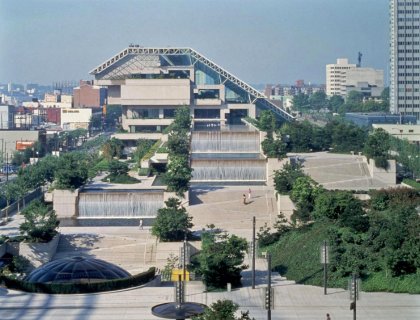
I had known of Arthur Erickson — perhaps one of his generation’s finest Canadian modern architects — and his Law Courts Building, designed and built between 1973 and 1980. The way one experiences it as a pedestrian when approaching it from Robson Square to the north fascinated me: you find yourself gently scaling the roofscape of this mammoth structure, which Erickson likened to a horizontal skyscraper.
Instead of building a large 200+ meter tower that would have blocked sunlight on the northern public spaces, Erickson argued that the building should be laid on its side, enabling people to walk all over it. Which is exactly what they do. Parks, terraces, water features, balconies, ramps, stairs, trees and vegetation inhabit this multi-layered roofscape. As you ascend the stairs and ramps, you are offered new vistas of Robson Square, the surrounding cityscape, and the northern mountains. The types of green spaces created on this roofscape range in scale and type, offering diverse settings for relaxing and enjoying your city views.

Eventually, a trek across this multi-block “built landscape” leads you to one of the building’s main entrances (the others are at ground / street level). Overhead, a large 60,000 SF glass canopy covers an expansive interior public arena of terraces occupied by courtrooms, offices and supporting spaces. The glass canopy is made of a space frame, a technique popular in the ‘60s and ‘70s. All walls between the terraces and canopy are glass (mostly without mullions), making the roof appear to float effortlessly overhead. This glass membrane also allows the exterior landscape and its plantings seamlessly into the court’s interior spaces and atrium.

While this building is worthy of its many awards, it is not without issues and critics. The structure is massive in scale. Its method of construction typified the “mega-structures” that enamored many modern architects of its era, many inspired by Le Corbusier’s heroic proposals for Rio de Janeiro and Algiers. These proposals combined infrastructure, housing and city life at the scale of city-making versus building. (Paul Rudolph, former Chairman of the Department of Architecture at Yale University, was also an enthusiastic designer of robustly built urban structures.) Mega-structures in general, and the Law Courts Building in particular, require a scale and level of infrastructure which is hard to tame at the street level, where pedestrians reside and urban life is made (or not). For all of the delight the roofscape creates, its urban streetscape is left wanting. It lacks the messiness and controlled chaos that enlivens streets. Perhaps it could be enhanced through aggressive transformations of the building’s first two floors, allowing for happenstance interventions and integrating a lively palette of materials, colors, surfaces and uses.
While clearly designed by an architect, this building is shaped as much by consideration of the landscape as it is by traditional urban architectural form. Thanks to Erickson’s bold design, the making of a new kind of urbanism found its place in this delightful city, well before “Landscape Urbanism” was even a term or a movement.
By Paul Lukez
All photos taken from arthurerickson.com
For further reading on Landscape Urbanism, see:
• Almy, Dean. “Center 14: On Landscape Urbanism.” Austin: The Center for American Architecture and Design, The University of Texas at Austin, 2007.
• Berger, Alan. Drosscape: Wasting Land in Urban America. New York: Princeton Architectural Press, 2006.
• Connolly, Peter. “Embracing Openness: Making Landscape Urbanism Landscape Architectural: Part 2,” in The Mesh Book: Landscape/Infrastructure, Julian Raxworthy and Jessica Blood, eds. Melbourne: RMIT University Press, 2004, pp. 200-219.
• Corner, James. Recovering Landscape: Essays in Contemporary Landscape Architecture. New York: Princeton Architectural Press, 1999.
• Czerniak, Julia. CASE—Downsview Park Toronto. Harvard University, Graduate School of Design. Munich and New York: Prestel Publishing, 2001.
• Kerb 15: Landscape Urbanism. Melbourne: RMIT Press, 2007. This issue includes contributions from Charles Waldheim, Mohsen Mostafavi, FOA, Karres en Brands, Kongjian Yu, Kyong Park, Kathryn Gustafson, Stephen Read, Kelly Shannon, Richard Weller, Sue Anne Ware, Cesar Torres, Peter Connolly and Adrian Napoleone.
• Koolhaas, Rem. “Atlanta.” S,M,L,XL. New York: Monacelli Press, 1999.
• McHarg, Ian L. Design with Nature. First edition. Steelville, Mo.: San Val, Incorporated, 1995.
• Mostafavi, Mohsen. Ecological Urbanism. Zürich: Lars Müller Publishers, 2010.
• Mostafavi, Mohsen, Ciro Najle, and Architectural Association. Landscape Urbanism: A Manual for the Machinic Landscape. London: Architectural Association, 2003.
• Topos 71: Traditions of Landscape Urbanism. This issue includes contributions from Charles Waldheim, James Corner, Mohsen Mostafavi, Adriaan Geuze, Susannah Drake, Kongjian Yu, Frederick Steiner, and Dean Almy.
• Waldheim, Charles. The Landscape Urbanism Reader. New York: Princeton Architectural Press, 2006.