









In Search of Timeless Design
The Avanti is not your father’s Oldsmobile
by: Paul Lukez
What defines “timeless design”?
This was precisely the question I asked myself on a recent visit to the Peabody Essex Museum (PEM) in Salem, Massachusetts, to see an extraordinary exhibit on William Turner, a painter of extraordinary vision and virtuosity. His experiments in depicting unusual atmospheric conditions and light were unparalleled at the time. One might argue that his painterly techniques were precursors to Impressionism.
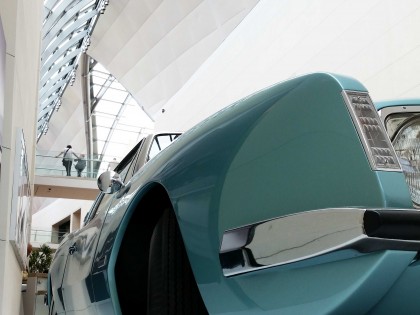
But upon exiting the museum, I caught a glimpse of a metallic turquoise-colored car sitting on a low podium. Strategically located in the museum’s Moshe Safdie-designed atrium, I was immediately struck by the car’s stunning lines, so fitting for the atrium’s curvilinear roof structure.
This automobile and its design are a thing to behold. It eclipses “your father’s Oldsmobile.” It is an objet-d’art.
It was none other than the 1963 Studebaker Avanti, designed by famed Industrial designer Raymond Loewy. What is more remarkable is the car’s age. (For more about Raymond Loewy’s biography and designs, see references below.)
How could a car designed and built some fifty years ago look so good, and so contemporary?
What made Loewy’s masterpiece able to transcend fashion and time?
These are questions we ask ourselves at PLA all the time, especially as they apply to architecture and urban design. How can we design spaces and places that will look good and feel right for years and decades to come? How can we build structures and forms that are of their time—i.e., created with contemporary materials and processes—but do not appear “dated” as the next fashion wave cycles through our cultural taste-making machine?
While these are big questions, here are some quick observations about what makes this auto so remarkable.
Style vs. Sense of Style
What struck me most about it were its graceful lines, which were more “Grace Kelly” than “Miley Cyrus.” Where Kelly is about eternal elegance, Cyrus is more about naked exhibitionism cloaked in crass commercialism.
Ultimately, the lines themselves define the skin of any object. The exterior envelope helps us to read the form and shape of a given mass. Clothing designers are masters at this, allowing the human body in its infinite form to be read and viewed differently, depending on the type and cut of fabrics cloaking a body.
At some point, every kind of designer (industrial designer, architect, fashion designer, etc.) must commit to a finite form. How to define the enveloping form, what materials to use, and how to mold it becomes a complex three-dimensional challenge for all designers.
Functionalism might advocate, “Form Follows Function”—a simplistic reading of a much more subtle problem. As Grace Kelly and the Avanti remind us, not all forms and lines are created equal. Loewy understood this, as is so evident when viewing his car’s stunning profile.


Scale and Proportion
Two stalwarts of design—scale and proportion—are essential to great design. Never was the importance of this more evident than when 3D modeling programs became more commonly available in the ‘80s and ‘90s. At the time, CAD and 3D modelling software would depict all lines as equal in size, regardless of the scale at which they were viewed. As you zoomed in and out of CAD Space, the lines defining shapes and volumes were the same; CAD Space could not measure a design relative to human scale. Consequently, many of my students produced initial model CAD studies with no sense of scale, so much so that they often surprised themselves when they built scale models.
Some might argue that you cannot discuss proportion without mentioning scale. Scale and proportion are the Siamese twins of design. Proportion implies a relationship between two or more things in space. Those two items—a house and its roof, a tie and suit jacket, etc.—have a dimensional relationship (or scale) we recognize as pleasing to the eye or not. Our judgments on that are influenced by many factors, including cultural filters. But we also have an intuitive sense of when a structural beam is too big, or a shoe too pointy. These visceral judgments are measured against all of the parameters that we automatically associate with each object or environment we are visually evaluating, be it a car, suit or human body. We instantly recognize if something is amiss without having to measure anything, so acute is our sense of proportion and propriety.
Loewy found the sweat spot in shaping a larger form made of many components—hood, carriage, windshield, doors, trunk, etc.—each scaled to be the “right size.” (Courtesy of my former teacher, Aldo Van Eyck.) More challenging, though, is that all components and parts that make up this object are perfectly sized and calibrated to each other, such that the net effect is pleasing to the senses and our minds.
So, two critical tasks face the designer: (1) to make sure each component is the right shape and size; and (2) to ensure that the relationship among all parts is appropriately configured and combined, visually and functionally.
Craft and Detail
Even if you shaped the perfect form with elegant lines and balanced a design’s proportions and scale, more qualities are required to make an object or design truly timeless. After all, each object must be made of material matter. Each material has its own associations, as well as a unique set of performance attributes. Clay is malleable, where glass is brittle. Steel is strong, where wood will splinter when overstressed. Understanding each material’s characteristic properties and physical limits enables the designer to select the appropriate material palette for a composition. When using multiple forms and/or materials, the designer must decide how to bring elements together in a way that works within the limits of each substance, pushing its performance where possible and appropriate.
This is where craft and detail come into play. How that is achieved is left to the designer. How the design is executed is left to the builder, fabricator or craftsperson.
Great design without great craft does not make a good final product. We will always be left wanting, knowing that something lacks if the craftsmanship is sloppily conceived or executed. Perhaps the craftsperson or fabricator did not have the technical skill and/or ability, or incorrect materials were selected for a particular design element. Sometimes it is a question not of technique or material, but of spirit. The spirit (or soul) the craftsperson invests in the product is readily evident. The care and dedication that went into one object or design is evident, as is the sloppy, haphazard assembly or scanty forethought of another.
Loewy achieved this goal with the Avanti in the most satisfying way. The way the rear glass window sweeps around the curve of the passenger cabin is sublime. Even better is how the chrome frame minimally anchors the glass to the body of the car’s sheet steel. He understood both the limits and the potential of glass as a pliable material, while understanding how to connect it to a larger assembly.
Loewy’s masterful display was years ahead of the sleek designs of the Audi in the late ‘90s. Audi was one of the first automakers to seemingly shrink-wrap the body of its A4s so that the glass and steel panels unified in continuous surfaces.
By being ahead of the curve of time and design advances, Loewy’s 1963 Studebaker Avanti will be resilient to vagaries of taste and fashion.
Final Comments
Other factors, of course, contribute to “timeless” design by, for example, providing “human-centric” and comfortable designs. But those topics will be addressed in a future blog.
So as you go through your daily lives and encounter the hundreds and thousands of objects and spaces that shape your daily experiences, ask yourselves which of these objects or spaces you would like to have around you in years or decades to come. Which ones will still be valuable and worthy of your attention and love? Which spaces and environments capture the spirit of a time and place, while being sustainable for the indefinite future?
These are the questions we ask at PLA as we take on the privileged task of designing places and spaces for our clients.
References
Loewy, Raymond. The Locomotive: Its Aesthetics. London: The Studio, Ltd., 1937.
Loewy, Raymond. Never Leave Well Enough Alone (autobiography). New York: Simon and Schuster, 1951.
Loewy, Raymond. Industrial Design. New York: The Overlook Press, 1979.