








OK, that might be a stretch—but can dancing and other forms of recreational activities help to reduce our dependence on fossil fuels? And, if so, by how much?
This is one of the questions we posed to our clients and community group at the Boys & Girls Club in Worcester as part of the Loom Works Project, a unique collaborative effort headed up by our strategic partner, McCabe Enterprises. The multi-disciplinary teams (see credits below) were tasked with contributing to a new plan for several sites in the Kilby-Gardner neighborhood in Worcester, adjacent to Clark University.
Our team was charged to run an “energy workshop” through which local residents would understand more about the role energy plays in their lives, as well as learn new energy-saving strategies—not only to save money, but also to make our planet a little “greener.” As a generational issue, raising awareness about energy and sustainable practices is especially important for our youth. Consequently, one whole day was devoted to children visiting from a local school.
But generating discussion about wattage, carbon footprints, and the breakeven financial analysis of energy conservation can be a challenge, even for the most animated speakers. To that end, our team relied on two crutches; 1) an energy producing dance floor, and 2) dynamic, hip infographics.
An innovative dance floor system was brought to Worcester courtesy of the Energy Floors company, based in Rotterdam, Holland. This Dutch firm invented an amazing system of tiled dance-floor panels designed to capture the energy generated by dancing on the glass tiles. Each tile measures about 2 ft. by 2 ft. The pressure-sensitive tiles are connected to micro-gears, which are activated by bouncing bodies, which in turn generates energy that is stored into each panel’s battery pack. The stored energy is then released to light up LED lights embedded in each panel. The more you dance, the more energy (and light) you will create.
We were able to get nine panels and one disc jockey (Peter Blesgraaf) to cross our borders and customs—and, boy, did those kids rock the Boys & Girls Club! Over 200 students were challenged to generate as much energy as they could, as either individuals or groups. As students showed off their dance moves, they could see how much energy they were creating, thanks to a real-time display of energy produced and stored. The competition got heated—so much so that it attracted the attention of a local TV station (http://goo.gl/pMVy3E).
The following day, the students and their parents were invited to a morning “Energy Fair,” which featured displays by NSTAR, Clark University, and National Grid. The McCabe team presented the results of the dance-off competition and explained the principles and concepts behind this novel energy generating technology. Colorful, playful infographics prepared by Matt Uminski (PLA) and Scott Medeiros (Woodard & Curran Inc.) clarified these ideas in a visually captivating, entertaining way. The goal was to make a dry topic (physics and money) fun and playful. All the while, valuable lessons were taught about energy production and consumption, some of which might influence how students and their families think about how they use and manage energy day-to-day.


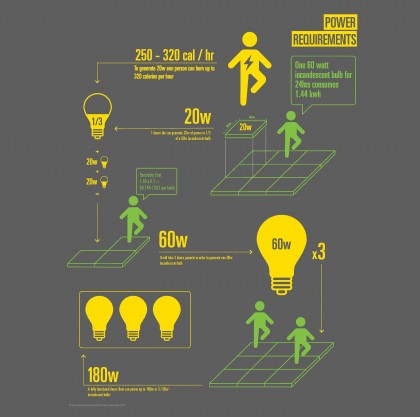
Matt and Scott’s enticing images show how much energy each dancing tile produces (20W). This is but one-third of the energy required to light a 60W incandescent bulb. By simply using a 10W LED bulb, the same amount of dancing could produce six times as much energy! That made a strong impression on the kids…less dancing generates more light!
Then the conversation moved to the carbon footprint created for each type of light bulb typically used in a home. A 60W Incandescent bulb produces 4.5 pounds of carbon if powered by coal over a 24-hour period, where natural gas produces only 1.3 pounds of carbon. A 10W LED light produces 0.75 pounds of carbon over 24 hours, while natural gas generates less than 0.2 pounds. Renewable energy sources, like solar and wind, produce no carbon.
It is hard to imagine what that really means, though. What does it mean for carbon to go into our atmosphere? That concept seems so abstract, especially since we can’t see it literally.
How much volume does one pound of carbon occupy? If carbon were a liquid when released (which it is not), it would equal approximately a standard 12-ounce can of soda, which weighs one pound.


Now the children’s eyes started to light up. “You mean that over four 12-ounce cans [or four pounds] of carbon are released in the air over 24 hours to run one 60-watt light bulb powered by coal, and only a fifth of a can if we use natural gas? That is a lot of dirty carbon!”
Of course, no carbon is released into the atmosphere when using renewable energy, which leaves us with cleaner air. Most importantly, the temperature of the planet doesn’t go up as much if we can increase our renewable energy production, since carbon acts like an insulator, trapping heat in our atmosphere.
The kids started to imagine how many cans of carbon were being released every day just to run the 20 to 60 lights in the standard household. Meanwhile, the parents wanted to know more about what this meant to their pocketbooks.
Matt and Scott came to the rescue again: their simple charts and infographics showed how much money could be saved in both the short- and long-term if they switched from coal-powered incandescent lights to cleaner fuel sources using LED lights. In the best scenarios, the average household could save more than $2,500 over ten years (based on 10 bulbs per household over ten years). They also discovered that the breakeven point would be somewhere between 1 and 3 years, depending on the type of bulbs used, as well as the energy source.
The meeting ended with students and parents re-charged and ready to find ways not only to use energy in a greener way, but also to have fun in the process. While we can’t generate all of our energy dancing alone, we can translate the experience of dancing into tangible lessons that can inform students and parents alike as we make smarter decisions about energy and our planet.
Thanks to our many partners in this endeavor, including:
• Peter Blesgraaf from Sustainable Dance Floors in Rotterdam (http://www.sustainabledanceclub.com)
• And the McCabe Enterprises Team:
Kathy McCabe
Jen Mecca
Scott Medeiros (Woodard and Curran)
Carolina Carvajal (CRJA)
Rocky Chen (PLA)
Matt Uminiski (PLA)
Paul Lukez (PLA)
Serrafix
Walkable and Liveable Communities Institute
• City of Worcester
www.worcesterma.gov / webmaster@worcesterma.gov
City Hall, 455 Main St. Worcester, MA 01608
(508) 929-1300
• Clark University
950 Main Street, Worcester, MA 01610
(508) 793-7711
admissions@clark.edu / http://www.clarku.edu/

ADDITIONAL NOTES
The Loom Works Livability and Crompton & Knowles Redevelopment Project is focused on developing an economically viable development plan for the redevelopment of 95 Grand Street, as well as a sustainability and connectivity plan and vision for the balance of the 8-acre Crompton & Knowles Loom Works site and Main South neighborhood overall. This project is funded through a Sustainable Communities Challenge Planning Grant from the Department of Housing and Urban Development (HUD) awarded to the City of Worcester. A separate component of the grant is helping to fund the redevelopment of 93 Grand Street into affordable housing.
The planning process will actively involve community residents and other stakeholders in fashioning a preferred scenario for the redevelopment of the vacant 2.4 acre city-owned brownfield site at 95 Grand Street; the creation of a master plan for the compatible integration and utilization of the remaining Loom Works buildings; and a sustainable development vision for the adjacent neighborhood.
95 Grand Street objectives:
To engage local residents in planning for the redevelopment of the site in a manner compatible with the neighborhood and to add to the employment opportunities in the area.
To determine the viability of suggested development scenarios.
To produce a master plan for the redevelopment of the site that is considerate of both community input and the requirement that it be financially feasible.
Crompton & Knowles Neighborhood objectives:
To develop a comprehensive neighborhood sustainability and connectivity plan that integrates the redevelopment of the mill complex into the ongoing revitalization efforts in the adjacent neighborhood.
To work to improve existing neighborhood infrastructure, amenities and green space within HUD’S Livability Principles to develop a plan that:
increases connectivity to downtown Worcester, Clark University, surrounding neighborhoods, and other adjacent resources;
improves the pedestrian environment and increases the use of alternative means of transport, such as transit, bike facilities and car share programs; and improves access to and utilization of recreational space including University Park, the new Boys and Girls club, and the new Clark University athletic fields.
To create a strategic revitalization plan to achieve the objectives stated above.
The Sustainable Communities Challenge Planning Grant
The Sustainable Communities Challenge Planning Grant funding was secured as part of a national grant competition with support from Congressman Jim McGovern. The grant was awarded to the City of Worcester, who serves as the fiscal agent.