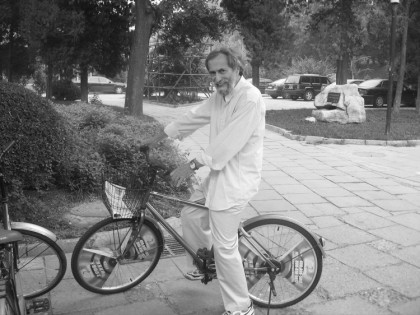









Professor Jan Wampler’s work as an educator and architect was prominently featured in New Architecture – a prestigious Chinese architectural journal. Jan asked me to write an introduction about him and his work.
I was very fortunate to have counted Jan as one of my mentors. Jan inspired hundreds, if not thousands of students during his long tenure as a Professor of Architectural Design at MIT, propelling his students to advance their design abilities beyond what they might have otherwise thought possible. I have come across many students from different generations and locations who attributed Jan’s guidance as being instrumental in shaping them as designers, professionals and educators today.
The following is the English text version of the introduction to the New Architecture Issue (01 / 2015) that highlights some of Jan’s remarkable journey as a teacher and designer.
This story begins along the train tracks outside of Marion, a town of some 30,000 people in central Ohio, in the 1940s. There stands an elementary school-aged boy, intently watching trains stream by from his favorite spot at the edge of a forest overlooking a horizon-grabbing prairie. He comes there most evenings in the summer to do his trainspotting. Sometimes he watches long strings of freight trains, whose friendly engineers wave to him in familiarity. When passenger trains journey through, he prudently observes people in the dining car eating their meals in seeming luxury as they scan the cornfields of Ohio. A mix of dense forests and rich farmlands defines this terrain, which is as typical in the Midwest as it is subtly varied. This boy wonders: Where are the trains going? Where are those passengers, dining in such refined settings, heading to as they pass through the town? What adventures await them in places far away?
This young lad spent his youth in small farm towns like Marion, where he was born in 1939. His elementary school was a simple one-room schoolhouse, the type you see in movies about the American frontier. A single devoted and caring teacher moved from desk to desk, organized in rows by grade. She covered multiple subject matters over six grade levels, while being sensitive to the varying abilities and learning stages of each student. One student in particular stood out—not so much because his performance was stellar, but because his curiosity and questioning knew no bounds. Why couldn’t he study history and geography with the older children? Why couldn’t he make imaginary cities and structures out of paper and recycled cardboard in class? Why couldn’t he just study the beautiful light patterns streaming through the window-shades on a golden autumn morn?
His questioning manner was as attributable to his environment and circumstances as it was to his DNA. His grandfather, a farmer of inquisitive intelligence, was president of the Ohio chapter of the Prairie Radicals, who opposed the ever-expanding power of both Government and Corporations—as if some of the libertarian objectives of today’s Tea Party and the more left-leaning Occupy Wall Street movement were merged into one faction. At its core, the Prairie Radicals represented a deeply individualistic, self-reliant strain in US political and cultural thought and history, which arose in part out of the daily necessities of surviving in the expansive, less densely populated plains of the Midwest. Here, farmers made land tillable where nature in its rawest form once dominated the landscape. They built self-sustaining communities through collaboration, not only as a means of survival, but also to promote conviviality and a sense of community.
This boy’s grandmother also had an independent streak. She was an early supporter and organizer of the Suffragette movement, challenging the male-dominated political structure by demanding equal rights for women—an entirely practical matter and expectation for farm families where their economic success depended as much on women’s contributions as it did on men’s.
The farm, the landscape, and the magic of the schoolhouse became rich territory for the boy’s mind to explore. At his grandparents’ farm, he cherished the courtyard space created by the farmhouse, barns and ancillary structures, where all of the farm’s daily life rituals were played out. They included preparing wagons and farm equipment, as well as organizing seasonal harvests. He befriended the animals as he tended to them. But he also explored nature’s wilder domains beyond the neatly organized geometry of the cornfields. As he went deep into the woods, he would cut across those train lines to a world afar.
He set out to learn more about this vast world beyond his mid-western farm town by reading anything he could lay his hands on. His mother gave him encyclopedia-like books (one a month) to nourish his appetite for learning. His love for architecture, even at an early age, was ignited by reading every architecture and design book he could find in local libraries, however limited the selection may have been. Through his immersion in readings about architecture, he discovered the work of Louis Sullivan, one of the first truly American architects. Sullivan sought to define an authentically American architectural language liberated of European stylistic dictates while embracing nature and technology.
Fast forward to the early 1950s, where, through determination and happenstance, this boy finds himself in Chicago, one of the destinations some of the dining-car passengers he so envied years ago might have gone. Since then, his mother had married a man who worked on the railroad, allowing free passage on trains for family and kin. Ever independent, the boy set out as a young teen to visit one of Louis Sullivan’s masterpieces in Chicago. The Auditorium Building, built in 1889, was a marvelous multi-use structure, programmatically and technical complex. It included theaters, offices, a hotel, and later Roosevelt University. The Auditorium Building commanded a powerful urban and civic presence with its grand arched entrances, Romanesque window arcade and 18-story tower, but was regrettably scheduled to be torn down. So the boy wanted to see it before its destruction. (It was ultimately spared the demolition team’s fate, thanks to the actions of historic preservationists and a committed citizenry.)
The boy arrives at the great edifice to visit the building and its grand interiors, embellished throughout with Art Nouveau foliate motifs and spiral scrolls. Not satisfied to navigate only the publicly accessible spaces, he decides to go to the building’s tower, where he knows Sullivan had his office decades ago. Why shouldn’t I see the tower? he wonders. And it is there, in the tower of Louis Sullivan’s magnum opus, that the boy (Jan Wampler) encounters another rule-bender, if not rule-breaker.

Frank Lloyd Wright stands before him. Through synchronicity, and perhaps fate, Wright had been touring the building with some of his staff. Wright also wanted to pay final respects to the work of his Lieber Meister, as he had called Sullivan when working under him. Wright was showing his staff the spaces and details he had helped design as a young draftsman in Sullivan’s office so many decades ago.
Wright asks Jan what he is doing here. Taken aback, Jan replies that he is an aspiring architect and wants to see this great work. Wright instructs him to study Sullivan’s designs and copy some twenty plates of Sullivan’s patterns, all of which were inspired by nature. “Send me your drawings,” says Wright, “and I will tell you if you have the ability and talent to be an architect.”
Fueled by the challenge, Jan finds the plates in his library and works diligently as he masters drawing and re-drawing the patterns from Sullivan’s designs. He sends them off to Wright, who invites him to come to study and work at his office in Taliesin. Jan rejects the offer, since Taliesin’s newly reconstituted program of study includes farming on Wright’s farmland. Having had his fill of farming, Jan seeks out another path, one less familiar and distant—at the end of the rail line, as it were.
He applies to the Rhode Island School of Design (RISD) and is accepted. Taking that train over the Hudson River and on toward the edge of the continent’s eastern seaboard, he finds himself in a learning environment where art and design are all-immersive. He engages in all RISD has to offer—but not without questioning everything he encounters. He confronts professors who want students to design fancy villas on picture-perfect hillsides with south-facing water views. Jan camps out on the site and proclaims it too beautiful to be built on. Instead, he insists on enhancing the landscape without buildings. Not one to compromise his deeply held convictions, he pays the price by being failed by his professors. Yet he was prepared to pay that price—as would happen again and again throughout his career.
For his final thesis, Jan proposes a fishing village in Nova Scotia. During his thesis semester he spends the winter in that Canadian province learning about the craft of boatbuilding and how it might help to shape a more communal architectural form—one that enhances the lives of its inhabitants. The Design Faculty roundly rejects his final project. Jan is finished at RISD, without a degree in hand.

However, his giant thesis model (made with the help of many friends) still lingers in the exhibit gallery days after the thesis reviews are complete. A temporary wall encases it so as to shield visitors from viewing the failed project. By chance, RISD’s new president, Bush Brown, is touring the architecture galleries, and asks what is behind the temporary walls. “Oh, it is a deviant project, given a failing grade by our design faculty,” is the reply. Nevertheless, Brown demands to see it. Impressed by its humane premise and thesis, he asks why there aren’t more projects like Wampler’s fishing village proposal. “This is exactly the type of project that RISD should be taking on,” he announces.
Soon Jan gets a call from President Brown. Uh-oh, he wonders, as if he has pushed things too far this time. No, he learns. The President wants to give him his degree immediately and would be pleased to have him come to the office to pick it up today—and, “Oh, by the way, I’d like for you to teach at RISD.” In the span of a day, he goes from being without a degree to getting one, along with a teaching position.
Such are the tales that mark this boy’s path to places remote from Marion, Ohio. And the stories don’t stop there, as his path takes twists and turns as surprising as they are to be expected of someone like Jan Wampler. After RISD, he is employed at the Boston Redevelopment Authority (BRA), an urban planning and design agency actively shaping Boston in the 1960s. Here he works on exciting new projects, including a proposal for a World Expo. Jan proposes a metabolist-like structure in the harbor—a floating city of sorts. Its infrastructure and spaces are fully integrated into the harbor’s shape and ecology. Nature and man co-exist with the aid of design and technology (sound familiar, Mr. Sullivan and Mr. Wright?).
On a more pedestrian scale, he works on proposals for new playgrounds in Boston’s more impoverished neighborhoods. He pours his heart and soul into his work—only to learn that the city is hiring a well-known architect from Holland to finish the job. Upon hearing the news, Jan storms into the Design Head’s Office and demands an explanation. After an animated discussion with the department head, Wampler is told that he can present his work to the new consultant when he arrives in Boston. Jan posts reams of drawings on the conference room walls as the BRA’s entire design department anxiously looks forward to his presentation. He presents his work to the noted architect—Aldo Van Eyck, co-founder of Team 10 in 1954—awaiting his response with anticipation. To everyone’s surprise, Van Eyck commends Jan for his thoughtful work. He then informs the BRA’s Department Head that they “don’t need Van Eyck,” since Wampler is doing such a commendable job. “And please,” he asks, “can I go to lunch with Mr. Wampler now?”
So begins Jan Wampler’s lifelong relationship with Aldo Van Eyck, who is as much of a friend to him as a mentor. In writing Jan’s letter of recommendation to the Harvard Graduate School of Design, Van Eyck simply scribbles a quick note to Dean Josep Lluís Sert, stating that Sert “must admit Wampler. If not, you will be sorry!” Wampler is admitted.
At Harvard, Jan continues to develop as an architect and urban designer as part of the LAUD graduate program. He establishes key relationships with more mentors and friends, including Jerzy Soltan, Jaqueline Tyrwhitt, Fumihko Maki, and, yes, Dean Sert, whose association with other Team 10 members—Alison and Peter Smithson, Shad Woods, and especially Giancarlo de Carlo—help Jan to get to know designers of like mind and spirit. (This would eventually lead him to participate in de Carlo’s future International Laboratory of Architecture and Urban Design (ILAUD), along with such luminaries as Renzo Piano, Sverre Fehn, Donlyn Lyndon, and Peter Smithson.)
After graduating from Harvard, Jan delves into his practice, applying what he learned from others and his own experiences. He wants to help a larger community through the process of design. He believes that, by enabling and empowering individuals, families and communities to meet their own needs—in the spirit of his Prairie Radical grandfather—he can create more lively, humanely built environments.
Remember, this is the 1960s in Cambridge / Boston. If there is ever a time for a Wampler-like designer to grow and flourish—one who can find his own voice while meeting underlying societal needs—the 1960s are the time, and Cambridge / Boston is the place. Jan’s deeply held beliefs about social justice, equity, nature, landscape, space, people, and their communities come to form through different projects and venues during this fertile, creative period.

Most notably, he works on a Puerto Rican housing / urban design project, which he submits to the Progressive Architecture (PA) Awards Program. Completely defying the trend that characterizes that prestigious honor at the time, Jan’s project is not about creating dramatic forms or spaces for their own sake. It is about making places for people. The space between forms and buildings is what occupies people’s lives and Jan’s imagination. And for this project, he receives the highly esteemed national PA Award he aimed for.
So impressed is one of the jurors with Jan’s entry that he summons him into his office. Lawrence B. Anderson, Dean of the School of Architecture and Planning at MIT, wants to chat with Jan about his project. Soon after their chat, the Dean’s assistant, Anne Shepley, calls Jan to ask for his Social Security number. A bit surprised, Jan asked if there is not going to be a formal interview process. “No,” he is informed. His “chat” with the Dean constituted an interview. And so, the fateful decision is made that Jan is to teach at MIT in 1969.
Now, some 46 years later, Jan has enjoyed a distinguished career as a practicing architect, teacher and author. His accomplishments and accolades are too numerous to mention here, but suffice it to say that his contribution to the design field has been transformative in many ways, shapes and forms.
As an architect, he is especially proud of his Angela Westover House in Jamaica Plain, Massachusetts, a congregate housing development. Instead of cramming elderly residents into nondescript housing units, Jan wanted the architecture to pull the residents together. Ever searching for community form, his project is organized in a way that both entices and requires residents to engage with nature and each other. The craft of the building further enriches the daily lives of its residents. Filtered, reflected and direct natural light streams into interior spaces—not unlike the way it did in his one-room schoolhouse back in Ohio. The patterns of light and shadow change throughout the day, as the soft amber glow of afternoon and evening light warms the hues of residents’ spaces and hearts. Handcrafted tile patterns are embedded into what are otherwise utilitarian concrete walls, elevating the mundane to something more sublime. The building’s massing flows with the site’s rolling topography, very much working reciprocally with nature’s forces and geometry. But its courtyard-like form also beckons the memory of his grandfather’s farm and courtyard. It is a place for the space between to support and engage human activity.
As might be expected, Angela Westover House did not come to life without significant obstacles typical of so many government-funded projects. Standards, guidelines, and requirements for this development were provided by the agencies with the usual bureaucratic efficiency. Jan, of course, questioned many of the government’s assumptions and dictates, wondering why the elderly could not be housed in more poetic, life-sustaining environments. But his tireless efforts yielded an award-winning residence which demonstrated that design could in fact generate new types of elderly housing that could give form to community and full living satisfaction to its residents.
As a teacher, Jan has taught more than 5,000 students at MIT and partnering universities in many other countries. He has helped to shape the way a generation of designers, teachers, and allied professionals think about architecture as not a mere commodity, but an endeavor that enriches people’s lives. He has broken the conventional mold of “teaching studio” as a studio-limited experience. He created highly flexible, effective ways of taking the studio to the site, both literally and figuratively.
His studios have spanned the globe, not simply as educational travel excursions, but as exercises that demonstrate how designers, planners and government agencies can work collaboratively to address pressing social and economic problems. His work on UN disaster-relief projects in Turkey, Haiti, Ecuador and other nations are great examples of how the studio can inhabit space outside the walls of a campus.
But, as anyone who had Jan as a studio professor knows, his studio experience is not simply about the transmission of design knowledge and skills. It is a transformative academic and personal experience like no other. His students consistently work harder and achieve more than they had ever imagined possible. Undergraduate work often looks more graduate-level, while graduate studio work takes on an even higher professional standard. Students stretch themselves beyond their limits, achieving what they might not have thought possible. The studio’s sense of camaraderie and community is infectious, where lifelong friendships are often formed. While students come away from their studios with a great deal of knowledge about design, architecture, culture, and cross-disciplinary factors related to a design project, they find themselves growing in unexpected ways. Ultimately, they discover themselves as “citizens of the world” as they engage in research, design, and action on society’s behalf.
I asked Jan what it was about his teaching that allowed him to create this experience for his students. Surprisingly, he could not provide a specific answer or set of guiding principles. As one who has worked in his studio and teamed with him side-by-side at MIT over several years, I have witnessed the magic of his studio many a time. It has provided me with a privileged vantage point, enabling me to speculate on this matter.
For me, Jan’s studio experiences are transformative for their students, because he dedicates himself to his students and his design work so selflessly. The energy and devotion he lavishes on his students and studio has set a standard of expectations for all involved: because he gives so much, he assumes everyone else will as well, should they be so inclined. But he also thinks of himself as both a teacher and a student who is always learning by asking questions. Like his teacher in Ohio, he shuttles from desk to desk, project to project, and studio to studio, ever seeking answers to the questions he and his students pose. Answers are discovered, not by books or theory alone, but through direct experience, experimentation and design explorations. The parallel process of making and testing hypothesis and spaces enables Jan and his students to learn from the studio experience and each other in a way that is personally powerful and transformative. Jan’s model is: life is learning, and learning is life. This model propels him as a designer and teacher, and by extension it propels his students in their endeavors.
Postscript
Jan Wampler has seen and visited places around the world that extend well beyond the limits of the rail lines that cut through his boyhood town. Today his journeys crisscross the globe as he continues to seek new territories of space and place in need of design intervention. Whether it is new design work for an Eco-City in war-ravaged Farmagusa, Cyprus, or for museums in China, Jan’s endeavors still start with questions.
This quest for asking the right questions is essential to Jan as a designer and teacher, for proper inquiry can make design transformative. For him, design has the capacity to change lives and to improve the quality of our personal and collective experiences. Perhaps most importantly, it can bring beauty to people and their communities. Beauty—a dangerous word, but one Jan does not avoid—is what connects us deeply to who we are as people and our role and relationship to nature and spirit.
Hopefully these notes on the making of Jan Wampler as an architect and humanitarian will help describe how, through his life experiences and design deeds, he has communicated his ideas to his students, partners and clients, as well as the communities he has served.
Paul Lukez is a practicing architect, former academic, and author. His firm, Paul Lukez Architecture (www.lukez.com) of Somerville, Massachusetts, is engaged in projects large and small in the US, Central America and Asia. Projects are informed by intensive research-based design explorations, and through multi-disciplinary collaboration with allied professionals (designers, engineers, scientists, etc.) His most notable projects in China include the PaoJiang Lake project in Zhejiang Province, the recipient of the prestigious Architectural Review (AR) Futures Awards Project in 2014. In addition, Paul has worked on large-scale sustainable projects in Xiamen, Hangzhou, and ShaoXing, among other worldwide locations.
He is the author of Suburban Transformations (Princeton Architectural Press, 2007) and a forthcoming book on The Mid-Polis Transformed, co-authored with Prof. Bao Li of Southeast University in Nanjing, China. He is a Fellow of the American Institute of Architects (2012) and a recipient of numerous design awards. He lives in Lexington, Massachusetts with his loving family, and is a great fan football (soccer).