










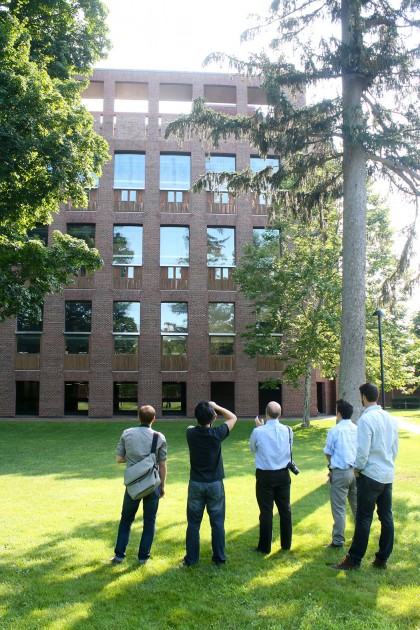
On a picture perfect New England summer morning, five junior members of the PLA team joined Paul Lukez, in visiting the Phillips Exeter Academy Library in Exeter, New Hampshire, famously designed by Louis Kahn.
Why were we on-site at the “Class of 1945 Library” last Friday? We were making a pilgrimage to one of the great libraries in the US to study and observe how the master-architect, Louis Kahn, designed this great brick library.
Currently, we are also working on a brick building, which offers us an invaluable experience to learn first-hand about the craft of designing a masonry structure of this caliber. We debated which lessons we could adopt from the structure of the library, to help, translate or morph our current brick project currently in progress in North Carolina.
As a firm dedicated to a research-based practice, we look at the best examples of architecture (new and old) to help inform ourselves about ongoing projects. The opportunity to walk the campus of Phillips Exeter Academy, and tour the building was great. Best of all, the Academy Archivist, Edouard Desrochers, generously pulled out the original as-built drawings, allowing our team to study the meticulously drawn large format drawings.
Exquisitely detailed blueprints documented each brick and their pattern. The drawings were graphically elegant – they were clear, simple yet complete – and all hand-drawn!
For those of you who are unfamiliar with Kahn’s Tour de Force, we encourage you to visit if you are in the area – and oh yeah – ask to see the original blue prints!

Architectural History:
With approximately 160,000 volumes on nine levels, the “Class of 1945 Library” is the second largest privately owned library by a boarding school, in the world.
Phillips Exeter Academy initially hired an architect who proposed a traditional design in 1960. Phillips Exeter Academy eventually came to scratch the architects vision, opting to go with a more contemporary design. Louis Kahn was targeted for the project and was later awarded the contract in 1965.
Kahn’s early designs of the library included a rooftop garden and two open exterior towers with staircases, which were eventually scratched from the PEA Design Committee. Due to design studies and specifics from the committee, the library went through more than 50 drafts.

While the library is planted on the end of a grass field, one may notice the corners of the library are chamfered (cut off) creating a slimmer view of the outer structure. The brick layout conceals the entrance of the building, while tiny patterns of brick emerge as once comes closer to the building. The glass windows are approximately eight feet tall.
The Class of 1945 Library looks somewhat plain and simple from the outside. Boasting a brick exterior, with a minimalist version of Roman archways at the bottom level, Kahn also developed a sleek entrance way, going against the obvious positioning of a classical entrance.
Architectural historian, Vincent Scully used a photo of the library as a cover for his booked, titled, “Modern Architecture and Other Essays.”


Within the first few steps inside of the library, a circular double staircase made from concrete greets the visitor. At the top of the staircase, the visitor enters a dramatic central hall with enormous circular openings. The atrium is fitted with two massive X beams, which filter light into the library from top glass windows. Kahn’s love of natural light led him to design spaces which maximized natural light to its full potential.
The inside dimensions of the building have a cubicle shape, with four sides equaling 111 feet wide and 80 feet tall. Kahn installed three massive concrete rings within the atrium. His aim was to inspire a, “building within a building” feeling with the central atrium being visible from all nine floors.


In November of 1971, Phillips Exeter Academy suspended class for the whole day, while students and faculty moved books (60,000 of them) from the old Davis Library, into Kahn’s newly constructed space. The Class of 1945 Library, houses a collection of works from past alumni by year, and also the Academy Archives from the previous year on the ninth floor. The archives are also surrounded by an exposed outdoor brick patio.
The library was also the first building to be fitted with ample conduit space for the coming computer revolution, a foresight seen by Louis Kahn. He also built a nearby dining hall, which shared heating and cooling units with the library.
With such a historic structure close to Boston, The Class of 1945 Library boasts an extraordinary look into the contemporary design of Louis Kahn and Associates. It is also open to the public year round.


 1 Comment