










As part of our efforts to continually improve and enhance PLA’s work environment and business practices, we reach out to successful businesses of all types and arrange for tours and follow-up discussions with their owners and/or managers. Besides getting the PLA team out of the office as a group, this is an opportunity for our team to witness first-hand the strategies that contribute to a business environment’s success.
This quarter, we reached out to Wilson Farm, located in nearby Lexington, Massachusetts. Wilson Farm’s incredible reputation for superior produce and service attracts customers from near and far. Jim Wilson, a direct descendant of one of the original founders of the farm, graciously spent over an hour with us. He shared stories of the farm’s rich history and answered our numerous questions.
The farm started out in 1884 as a modest 16-acre field. Today it grows seasonally fresh produce on 33 acres in Lexington and 500 acres in Litchfield, New Hampshire. As recently as the 1970s, the farm had merely a small roadside stand along Pleasant Street in Lexington, until they built a larger, beautifully crafted wood structure from reclaimed California timbers. (The Wilsons had been thinking sustainable and green for decades already!) More recently, a new addition was built onto the farmstand to accommodate the company’s growing retail demand. In what is a very competitive market sector (think Whole Foods, Wegmans, etc.), Wilson Farm continues to grow and strengthen its customer base.
How do they do it? What strategies have sustained the farm’s success since its founding? As we toured the facility with Jim Wilson, we saw powerful evidence of Wilson Farm’s winning strategies. Our observations follow:

Quality
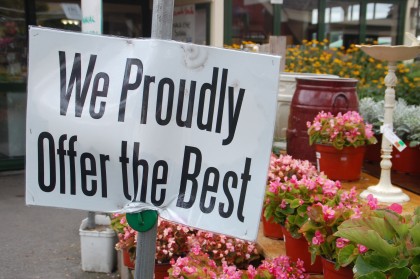
Everything about the Wilson Farm exudes QUALITY.
Upon entering, one cannot help but notice the beautifully polished fruits and vegetables. Not only is every produce item of the highest quality, but also its presentation is carefully and creatively arranged. Each day is a new experience for regular clientele. The layout and design of the display areas are rearranged daily, allowing for seasonal influences while providing repeat customers with a fresh, exciting new look each time they return.
The staff are super-friendly. Even while restocking shelves and bins, they are readily available for questions. You can tell that the staff (over 300 strong) work very hard and are dedicated to the farm’s mission and commitment to excellence.
As designers, we appreciated the way the farm’s visual delights provided an enriching, enticing customer experience. Visiting Wilson Farm is more than a utilitarian shopping exercise—it is an experience customers look forward to in their busy lives.
Lessons learned: The pursuit of Quality is paramount, and must be understood by everyone in the organization. Quality of service is as important as quality of product.

Operations
Even in a competitive business environment, the Wilson Farm leadership understands how to create the best available product as efficiently as possible. Jim’s approach is very hands-on. He told stories of how he occasionally works side-by-side with his staff in the field, demonstrating lessons learned from past generations of seasoned farmers. Besides creating a sense of camaraderie, valuable counsel is passed on to the present team. This collaborative, participatory approach also enables management to better understand the mood of the organization’s staff.
Running a successful operation requires constant learning. Jim is always in touch with other operators and business experts to learn the latest and best practices. He integrates these into his organization, testing and monitoring them over time.
The results are impressive, as his farm generates between two and three crop yields per season (depending on the type of crop and the season of the year).
Lessons Learned: High-quality operations require constant hands-on attention to the details of the operational process. Learn and apply the best practices while working side-by-side with your team.

Culture
This successful family business has created a very strong bond between management and employees. In fact, Jim refers to “family” as a model for his team. Management recognizes that a happy staff will be friendlier and more productive. To that end, the farm organizes staff picnics, games and other regular events.
But the staff also understands the Wilson Farm Culture and Vision: an overriding commitment to quality. This commitment, including every staff action, is immediately evident to visitors. Employees are also empowered to be proactive. When an issue must be addressed, they tackle it head-on.
Lessons Learned: An organization’s culture is all-important. It is driven by shared values and communicated in the daily actions of management and team.

Community
First and foremost, Wilson Farm aims to create a strong sense of community. It does so by recognizing an organization as part of a larger network of personal, business and neighborhood relationships and liaisons.
Second, the farm recognizes its patrons as part of this community: customers come to Wilson’s because they value quality healthy food and excellent service. In turn, the farm celebrates its customers by hosting seasonal events: in the fall, crop mazes, family hayrides, and a great tent filled with free samplings of Thanksgiving delicacies. And when the Red Sox win American League pennants and World Series championships, the fields are creatively and colorfully transformed.
Third, Wilson Farm contributes to the local and regional community. The farm sponsors special programs tied to the local Bowman Elementary School, which over the years have raised thousands of dollars for charitable causes. In addition, the business sponsors a large team for the Pan-Mass Challenge bike ride to support cancer research.
Lesson Learned: Never forget your commitment to community—your team, your customers, and local institutions. Without them, you would not exist.
Final Observations:
After the tour, the PLA team explored Wilson Farm’s facilities and grounds. We also selected a lunch from among a wide range of tasty choices. Not only had we been fed a nourishing lunch, but we took away invaluable lessons from this iconic business. Wilson Farm is more than a farm, grocery store, or market—it is an experience one would want to repeat again and again.
We appreciate Jim Wilson’s willingness to share his time and experiences with us. We wish him and his farm continued success.
Invitation:
If you own or operate a business and would like to share your best practices with us and our audience, feel free to contact us at info@lukez.com.
Text By: Cameron King Paul Lukez and Todd Larson

 1 Comment